
Threat Hunter: Hands-On Threat Hunting & Blue Team Guide
£ 29.99
Threat Hunter by Codelivly is a 385-page, hands-on guide to cyber threat hunting and detection engineering, organized around the MITRE ATT&CK framework. Its 108 chapters cover hunting across Windows, Linux, network, and cloud environments, plus threat intelligence, detection-as-code with Sigma and YARA, purple teaming, and incident reporting — written for SOC analysts, threat hunters, detection engineers, and blue teams.
Paying with an express button gives you instant access to your download, and you agree that all sales are final and you lose your 14-day right to cancel (see the refund policy).
Preview This Book
Explore a sample of this book before purchasing the complete edition.
Preparing your preview…
Description
Threat Hunter — The Complete Guide to Threat Hunting, Detection Engineering, MITRE ATT&CK, Incident Investigation, Threat Intelligence, and Modern SOC Operations
By Codelivly · First Edition · 385 pages · 108 chapters · 12 parts · 8 appendices
Stop waiting for alerts. Start hunting.
For two decades, cyber defense has leaned on a reactive model: deploy tools, wait for something to fire, and respond. Modern adversaries have made that model obsolete. They live off the land, blend into legitimate activity, disable logging, and move patiently through networks — exactly the behavior that signature-based alerting is worst at catching. Threat Hunter is the complete, hands-on answer: a single reference that teaches you to proactively find intrusions that slipped past every control, and to turn what you learn into durable, automated detection.
This is not abstract theory, and it’s not a scattering of one-off tricks. It’s a structured, repeatable methodology combined with concrete, platform-specific craft — organized around the MITRE ATT&CK framework and grounded in the real telemetry defenders work with every day. Every chapter is built to be used, not just read.
Who this book is for
- SOC analysts ready to move beyond alert triage into proactive, hypothesis-driven hunting
- Aspiring and practicing threat hunters who want a complete methodology, not fragments
- Detection engineers building, testing, tuning, and maintaining detections as code
- Incident responders who need stronger hunting and scoping skills
- Blue teamers and security engineers responsible for visibility, logging, and coverage
- Students and career changers seeking a rigorous, hands-on path into a high-demand specialty
- Team leads and managers who need to understand coverage, metrics, and program value
A working familiarity with operating systems, networking, and basic security concepts helps, but the book builds from foundations so motivated newcomers can grow into it.
What’s inside — the complete breakdown
Part I — Threat Hunting Foundations (12 chapters). The mindset, models, and vocabulary every hunt depends on: what threat hunting is; how it differs from detection engineering and incident response; the hunting lifecycle; hypothesis-, intelligence-, and data-driven hunting; a full MITRE ATT&CK overview; the Cyber Kill Chain; the Diamond Model of Intrusion Analysis; the Pyramid of Pain; and a career roadmap for the threat hunter.
Part II — Enterprise Visibility (11 chapters). The data every hunt is built on: Windows logging, Linux logging, Sysmon, PowerShell logging, authentication logs, DNS, firewall, proxy, and VPN logs, cloud logs, and endpoint telemetry — including what each source can and cannot tell you.
Part III — Threat Intelligence (9 chapters). Turning intelligence into outcomes: indicators of compromise (IOCs), indicators of attack (IOAs), threat actors and APT groups, tactics/techniques/procedures (TTPs), ATT&CK mapping, intelligence sources and validation, and operationalizing intelligence into hunts and detections.
Part IV — Detection Engineering (9 chapters). Building detections that last: the detection lifecycle, detection-as-code, writing Sigma rules, writing YARA rules, log parsing and normalization, detection tuning, reducing false positives, measuring detection coverage, and testing and validation.
Part V — MITRE ATT&CK Deep Dive (12 chapters). A tactic-by-tactic detection and hunting playbook covering every ATT&CK tactic: Initial Access, Execution, Persistence, Privilege Escalation, Defense Evasion, Credential Access, Discovery, Lateral Movement, Collection, Command and Control, Exfiltration, and Impact.
Part VI — Windows Threat Hunting (9 chapters). Hunting PowerShell abuse, the registry, scheduled tasks, Windows services, startup and autostart locations, Windows event logs, Sysmon events, lateral-movement indicators, and Windows timeline analysis.
Part VII — Linux Threat Hunting (9 chapters). Hunting SSH activity, cron and scheduled jobs, systemd abuse, Linux authentication, Linux processes, Linux persistence, bash history and shell activity, Linux system logs, and network connections with timeline analysis.
Part VIII — Network Threat Hunting (10 chapters). Hunting DNS, HTTP, TLS/encrypted traffic, SMB, RDP, network-side SSH, VPN, and DHCP, plus hunting with Zeek logs and analyzing Suricata alerts and PCAP traffic.
Part IX — Cloud Threat Hunting (7 chapters). Identity-first cloud hunting across Microsoft Entra ID, Microsoft 365, AWS CloudTrail, Azure Activity Logs, and GCP Audit Logs, plus cloud identity and federation, and building durable cloud detection, logging, and continuous monitoring.
Part X — Hunting Methodologies (8 chapters). The repeatable craft: building hypotheses, scoping hunts, evidence collection, timeline building, behavior analysis, validation, escalation, and documentation.
Part XI — Purple Team Operations (6 chapters). Measuring and improving real coverage: adversary emulation concepts, detection validation, purple-team ATT&CK mapping, tabletop exercises, SOC collaboration, and continuous improvement.
Part XII — Reporting & Communication (6 chapters). Turning findings into decisions: the executive summary, technical findings, evidence and timelines, detection recommendations, lessons learned, and metrics/KPIs for a hunting program.
Appendices A–H. A working reference set: an ATT&CK tactic cheat sheet, a Sysmon event ID reference, a Windows event ID reference, a Linux log and artifact reference, a Sigma and YARA quick reference, query-language concepts (SPL / EQL / KQL), hunting/detection/incident checklists, and a glossary of key terms.
How every chapter is built
Each chapter follows a consistent, learn-by-doing structure so you always know where to find what you need:
- Learning objectives that frame the outcome
- A grounded explanation of the behavior and the telemetry that exposes it
- Tables and diagrams that make relationships clear
- Detection recipes in a portable, Sigma-style format — each with its likely false positives, because tuning is part of the job
- MITRE ATT&CK mappings for shared classification
- Investigation guidance for working a finding step by step
- Callout boxes — Blue Team Notes, Threat Hunting Tips, Investigation Tips, and Warnings
- Real-world case studies showing the technique in action
- Common mistakes to avoid
- A hunt-hypothesis bank you can run immediately
- A hands-on lab to build the skill
- Review questions to lock it in
What you’ll be able to do
- Run hypothesis-driven, intelligence-driven, and data-driven hunts end to end
- Engineer, test, tune, and maintain detections as code with Sigma and YARA
- Hunt confidently across Windows, Linux, network traffic, and the cloud
- Detect every MITRE ATT&CK tactic, from initial access to impact
- Convert threat intelligence, IOCs, and IOAs into durable, low-false-positive detections
- Master endpoint, network, and identity telemetry — Sysmon, auditd, Zeek, Suricata, SIEM, and EDR
- Reconstruct attacks with multi-source timeline analysis and scope intrusions accurately
- Run purple-team exercises, validate detection coverage against ATT&CK, and continuously improve
- Communicate findings in reports that drive real decisions and measurable program value
Practical, defensive, and ready to use
Everything in this book is oriented toward defense: which log to pull, which field to pivot on, which behavior separates malicious from benign, and how to turn a finding into a tuned, tested control. Hands-on labs run in a modest, isolated environment — a Windows host and a Linux host with Sysmon and auditd, shipping logs into a free SIEM such as Wazuh or the Elastic Stack, with Zeek for network telemetry and free-tier accounts for cloud exercises. A fully clickable table of contents and PDF outline make the book easy to navigate as both a linear course and a day-to-day reference.
Whether you’re running your first hunt or building a hunting program for an enterprise, Threat Hunter gives you both the mental models and the concrete, repeatable craft to catch what everything else misses.
The adversary is already practicing. So should you.
FAQ block
Is this book for beginners or experienced professionals?
Both. It builds from foundations — the mindset, models, and telemetry behind threat hunting — so newcomers can start from scratch, while the platform-specific parts and the MITRE ATT&CK deep dive give experienced SOC analysts, hunters, and detection engineers advanced, reference-grade material.
What topics does Threat Hunter cover?
Threat hunting foundations, enterprise visibility and logging, threat intelligence, detection engineering, a full MITRE ATT&CK tactic-by-tactic deep dive, and dedicated hunting for Windows, Linux, network, and cloud — plus hunting methodologies, purple teaming, and reporting. Eight appendices provide cheat sheets, event-ID references, and a glossary.
Does it cover cloud threat hunting?
Yes. An entire part is dedicated to cloud, with identity-first hunting across Microsoft Entra ID, Microsoft 365, AWS CloudTrail, Azure Activity Logs, and GCP Audit Logs, plus cloud identity/federation and continuous monitoring.
What tools and skills will I learn?
You’ll work with Sysmon, auditd, Zeek, Suricata, SIEM, and EDR telemetry; write detections in Sigma and YARA; apply detection-as-code practices; run hypothesis-driven hunts; reconstruct attacks with timeline analysis; and validate coverage through purple teaming.
Is it hands-on?
Every chapter ends with a hands-on lab, plus hunt-hypothesis banks, detection recipes, case studies, and review questions. A modest home lab (a Windows and Linux host with Sysmon/auditd, a free SIEM like Wazuh or Elastic, and Zeek) covers most exercises; cloud labs use free-tier accounts.
Is this an offensive/hacking book?
No. Threat Hunter is strictly defensive and blue-team focused — every technique is oriented toward detecting, investigating, and stopping adversaries in environments you own or are authorized to protect.
Who is the author?
Threat Hunter is published by Codelivly.
What format is the book?
A 385-page PDF with a fully clickable table of contents and PDF outline for easy navigation as both a linear course and a day-to-day reference.
Related products
-
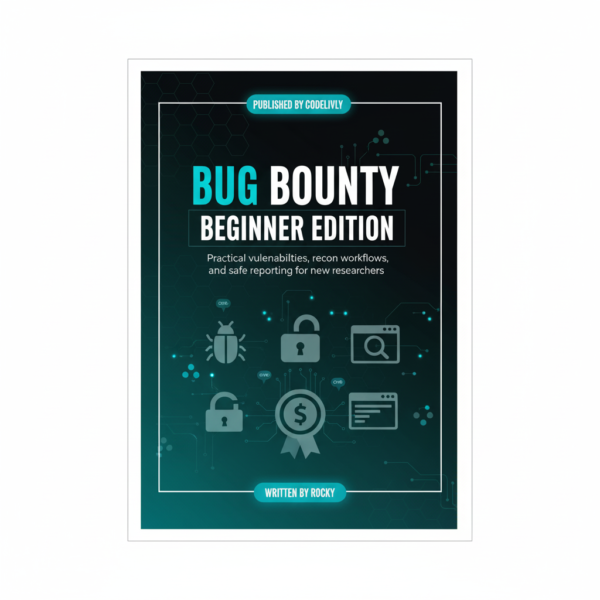
Bug Bounty Beginner Editions
Learn how to start bug bounty hunting in 2026. Master Burp Suite, SQL Injection, and XSS…
£ 9.99 Grab Yours -
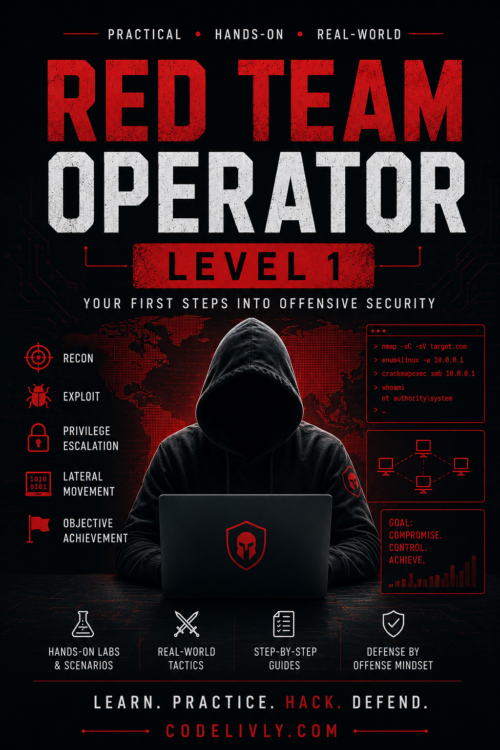
Red Team Operator L1: Offensive Security for Beginners
Break into the world of offensive cybersecurity with practical, real-world Red Team skills. Whether you're an…
£ 29.99 Grab Yours -
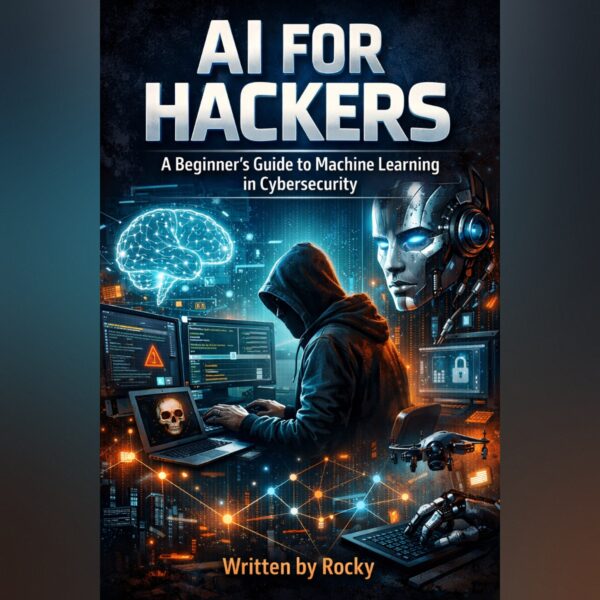
AI for Hackers: A Beginner’s Guide to Machine Learning in Cybersecurity
You’ll also learn how to build an AI hacking lab using Python, PyTorch, Scikit-learn, and transformer…
£ 0.00 Grab Yours
Frequently asked questions
How long is the Threat Hunter book and how is it organised?
Threat Hunter by Codelivly is a 385-page first edition organised into 108 chapters, 12 parts and 8 appendices. Part I alone covers threat hunting foundations across 12 chapters: what threat hunting is, how it differs from detection engineering and incident response, and the mindset, models and vocabulary every hunt depends on.
Who is Threat Hunter written for?
It is written for SOC analysts moving beyond alert triage into hypothesis-driven hunting, aspiring and practising threat hunters, detection engineers, incident responders, blue teamers, students and career changers, and team leads who need to understand coverage and metrics. A working familiarity with operating systems, networking and basic security concepts helps.
Does the book cover cloud hunting and detection-as-code?
Yes. Its 108 chapters cover hunting across Windows, Linux, network and cloud environments, plus threat intelligence, detection-as-code with Sigma and YARA, purple teaming and incident reporting. The methodology is organised around the MITRE ATT&CK framework and grounded in the real telemetry defenders work with every day.

Reviews
There are no reviews yet.