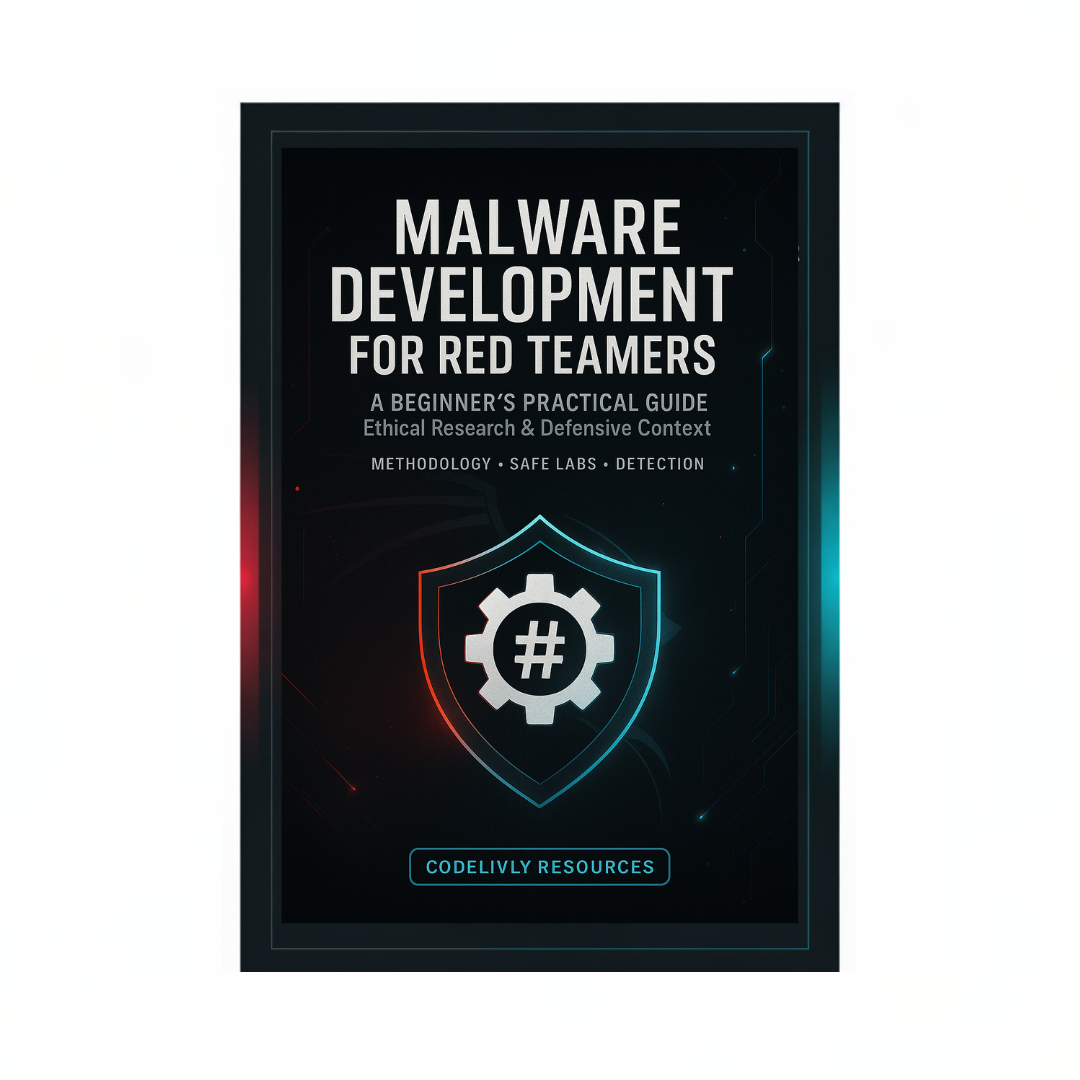
Practical Malware Development Handbook for Red Teams
£ 0.00
Move beyond automated tools and become a practitioner of your craft. Practical Malware Development Handbook for Red Teams provides the knowledge, the code, and the context to advance your skills and elevate your organization’s security posture.
Get all of them for £ 49.99 and save 32% on buying them one by one.
- Format
- PDF, instant download, DRM-free
- Length
- 330 pages
- Level
- Advanced
- Language
- English
- Publisher
- Codelivly
Preview This Book
Explore a sample of this book before purchasing the complete edition.
Preparing your preview…
Description
330+ pages of tradecraft | 5 hands-on labs | Build custom malware for authorized red teaming.
In modern cybersecurity, the most effective defenders are those who can think and build like advanced attackers. Practical Malware Development Handbook for Red Teams is a comprehensive, code-centric guide designed for security professionals who need to master the art of custom malware creation for authorized adversary simulation, penetration testing, and defensive research.
This is not a theoretical overview. It is a hands-on manual that takes you from setting up a secure, isolated lab to writing sophisticated, stealthy malware.
Inside, you will master a complete offensive skillset, structured for progressive learning:
- Part 1: The Foundation – Build your secure cyber lab, master essential tools (compilers, debuggers), and get a crash course in the critical languages: Python for rapid prototyping, C/C++ for native Windows payloads, and x64 Assembly for shellcode.
- Part 2: Core Malware Techniques – Engineer the modern malware lifecycle with loaders, droppers, and payloads. Establish persistent footholds on Windows and Linux and learn fundamental evasion techniques using encryption, packers, and obfuscation.
- Part 3: Communication & Control – Architect robust Command & Control (C2) systems. Learn to build HTTP beacons, implement covert DNS tunneling, and secure your communications with TLS to mimic real Advanced Persistent Threats (APTs).
- Part 4: Going Further & Staying Safe – Elevate your tradecraft with essential post-exploitation: credential harvesting (LSASS, Linux shadow files), lateral movement (PsExec, WMI), and token impersonation. Crucially, learn to “Think Like a Defender” by understanding EDR and logging, and master Operational Security (OpSec) to operate cleanly.
- Part 5: Practical Application – Solidify your knowledge with five end-to-end mini-labs, culminating in a full attack chain exercise that integrates everything you’ve learned.
Key Features:
- Ethics-First Approach: Grounded in the legal and ethical responsibilities of red teaming, with an emphasis on authorization, scope, and safe containment.
- Hands-On Code: Learn by doing with practical, real-world code examples in multiple languages that you can adapt and extend in your own lab.
- Defender’s Mindset: Each offensive technique is paired with insights into how defenders detect it, enabling you to build more evasive tools and, in turn, more effective defenses.
- Cross-Platform Tradecraft: Covers advanced techniques for both Windows and Linux environments, reflecting the reality of modern enterprise networks.
This book is an essential resource for:
- Red Team Members & Penetration Testers seeking to develop bespoke, framework-agnostic capabilities.
- Malware Analysts & Reverse Engineers who want to understand how malware is built to better deconstruct it.
- Blue Team & SOC Professionals aiming to deeply understand adversary Tactics, Techniques, and Procedures (TTPs) to create superior detections.
- Security Engineers building defensive tools and requiring an intimate knowledge of the threats they face.
Move beyond automated tools and become a practitioner of your craft. Practical Malware Development Handbook for Red Teams provides the knowledge, the code, and the context to advance your skills and elevate your organization’s security posture.
3 reviews for Practical Malware Development Handbook for Red Teams
Frequently asked questions
What is included in the free malware development handbook?
The handbook offers 330+ pages of tradecraft and 5 hands-on labs for building custom malware for authorized red teaming. It is structured for progressive learning across five parts: the foundation and secure lab setup, core malware techniques, communication and control, going further and staying safe, and practical application.
Which languages and techniques does it teach?
Part 1 gives a crash course in the critical languages: Python for rapid prototyping, C/C++ for native Windows payloads, and x64 Assembly for shellcode. Later parts cover loaders, droppers and payloads, persistence on Windows and Linux, evasion using encryption, packers and obfuscation, HTTP beacons, covert DNS tunneling, and TLS.
Is the handbook legal and ethics-focused?
Yes. It takes an ethics-first approach, grounded in the legal and ethical responsibilities of red teaming, with an emphasis on authorization, scope, and safe containment. It is designed for authorized adversary simulation, penetration testing, and defensive research, and teaches you to think like a defender by understanding EDR and logging.

Zamine –
Great for intermediate and advance users. As a beginner it’s hard for me to get started but beginner concepts are also cleared but not indepth
Jalica –
Amazing it’s full of Pratical and code
Bastul –
Halirious man thanks for this.