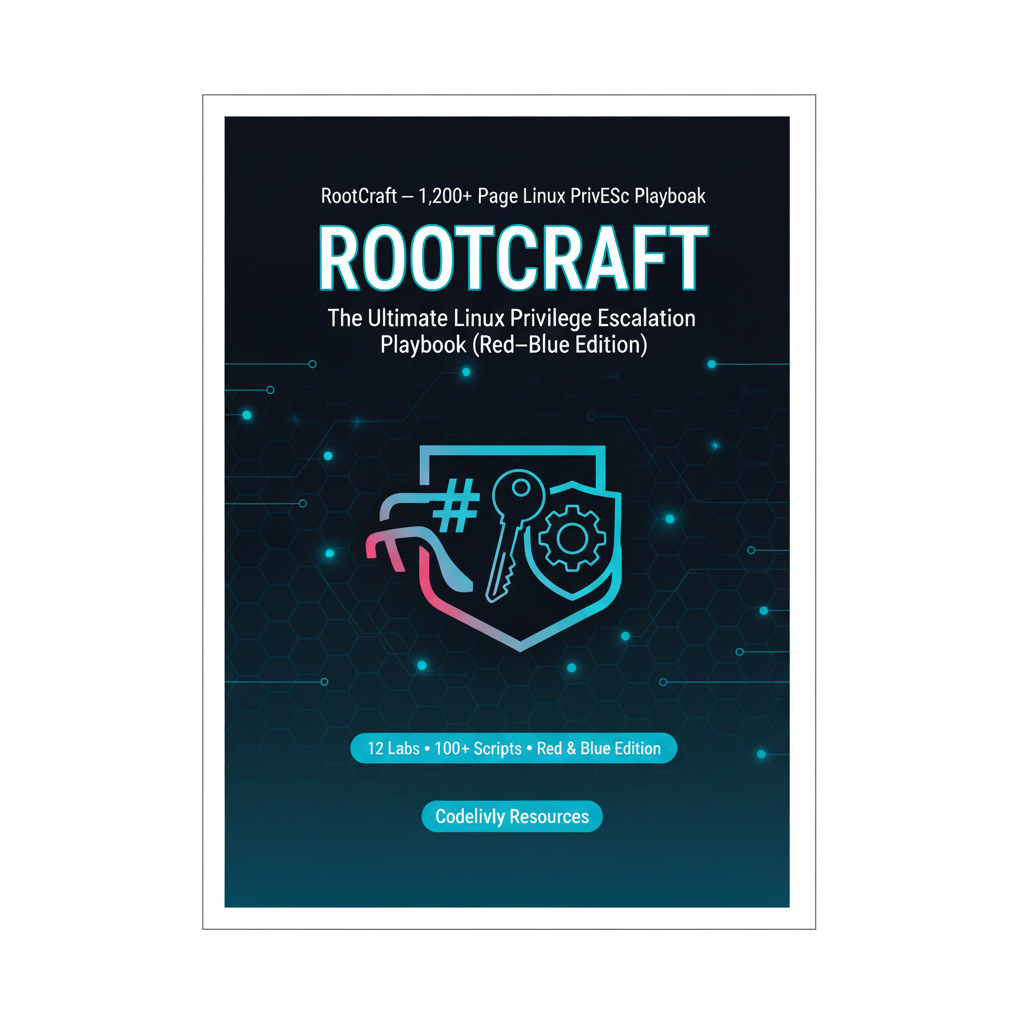
RootCraft: The Ultimate Linux Privilege Escalation Playbook (Red–Blue Edition)
$ 29.99
The only Linux privilege-escalation playbook you’ll ever need. Step-by-step enumeration, risk scoring, safe validation, lab PoCs, and hardening checklists — built for attackers and defenders. Practice in your lab, report with confidence, fix for the long term.
Description
1200+ Pages • 12 Hands-on Labs • Scripts, Enumeration Flows & Hardening Framework
RootCraft: The Ultimate Linux Privilege Escalation Playbook (Red–Blue Edition) is a hands-on guide that shows how attackers escalate from limited access to full system control and, importantly, how defenders stop them. It’s practical, safety-first, and built for real labs and real environments.
The book covers focused enumeration (the LAYERS approach), risk scoring, safe validation, and lab-only proof-of-concepts, plus a large catalog of vectors like SUID/SUDO misconfigs, cron weaknesses, container escapes, and cloud metadata abuse. Every offensive technique is paired with clear defensive controls, monitoring recipes, and remediation steps.
What You’ll Learn
- Modern Scenarios – Containers, Cloud, CI/CD pipelines, IoT, and emerging AI-assisted exploitation.
- Privilege Escalation Fundamentals – Understand why privilege escalation is at the heart of every real attack chain.
- Enumeration Mastery (LAYERS Framework) – Learn professional-grade discovery techniques used by elite red teams.
- Risk Analysis & Prioritization – Transform raw findings into actionable intelligence with quantitative risk models.
- Safe Validation Techniques – Confirm vulnerabilities without crashing systems or corrupting data.
- Proof-of-Concept Development (Lab-Only) – Build, test, and document exploits ethically in isolated environments.
- Defense Strategies & Blue Team Countermeasures – Harden systems, audit privilege vectors, and close the gaps attackers exploit.
Note: page allocations are approximate to help readers navigate a 1,200+ page reference.
1. Introduction & Legal / Ethical Guidance (pp. 1–40)
Why privilege escalation matters, legal rules of engagement, lab setup, authorization boundaries, and safety-first practices. Essential for every reader — mandatory reading before you run a single command.
2. Methodology: The 5-Step PrivEsc Workflow (pp. 41–110)
A reproducible, professional workflow: Enumeration → Risk analysis → Safe validation → Lab PoC → Remediation & documentation. Includes templates and flow diagrams.
3. Foundational Enumeration Techniques (pp. 111–240)
Deep, practical coverage of user/group analysis, filesystem discovery, processes/services, network, package inventories, kernel info, and Linux capabilities — with 100+ command examples.
4. SUID/SGID & File Permission Escalation (pp. 241–320)
Mechanics, discovery patterns, common vulnerable binaries, world-writable risks, and inheritance pitfalls — plus exploit/defense case studies.
5. Cron, systemd timers & Scheduled Tasks (pp. 321–380)
Where scheduled jobs go wrong, detection techniques, path manipulation, exploit templates, and secure configuration patterns.
6. Weak Sudoers & Sudo Misconfiguration (pp. 381–460)
Sudoers anatomy, discovery, NOPASSWD and dangerous rules, safe verification, and hardened sudo policies.
7. Credential Exposure & Secrets Management (pp. 461–540)
Environment variables, history files, config files, in-memory secrets, private keys — plus secret rotation and secure storage best practices.
8. Service Misconfiguration & Sensitive Binaries (pp. 541–620)
Service permission models, web app privilege contexts, backup tools, package managers, and service dependency escalation.
9. Kernel & Exploitability Assessment (pp. 621–700)
Kernel version mapping, CVE research workflow, exploit selection criteria, and safe testing of kernel-level issues. Patch strategies and kernel hardening.
10. Privilege Escalation Hardening Framework (pp. 701–820)
Actionable hardening: users & ACLs, permission audits, service/process security, scheduled task monitoring, network service hardening, update and patch practices.
11. Hands-on Lab Exercises (pp. 821–1200+)
Fully guided labs from basic to advanced: SUID/Sudo/Cron/Secrets/Kernel/Container escape, combined attack chains, full end-to-end scenarios, and defensive monitoring/hardening labs. Each exercise includes lab setup, expected outputs, PoC code (lab-only), rollback steps, and instructor notes.
2 reviews for RootCraft: The Ultimate Linux Privilege Escalation Playbook (Red–Blue Edition)
Related products
-
The Ultimate Virtual Private Network (VPN) Guide
The Ultimate Virtual Private Network (VPN) Guide is your all-in-one handbook for online privacy and security.…
$ 0.00 Grab Yours -
Linux Playbook For Hackers – Advanced Edition
The Linux Hacker’s Playbook – Advanced Edition is a hands-on continuation of Linux Playbook for Hackers,…
$ 19.99 Grab Yours -

Practical Malware Development Handbook for Red Teams
Move beyond automated tools and become a practitioner of your craft. Practical Malware Development Handbook for…
$ 0.00 Grab Yours

Naman –
Dense but readable. The cheatsheet + one lab got me up to speed fast. Worth every penny
Mikhail Petrov –
Clear steps, smart enumeration tips, and realistic examples. exactly what I needed to level up my Linux pentesting