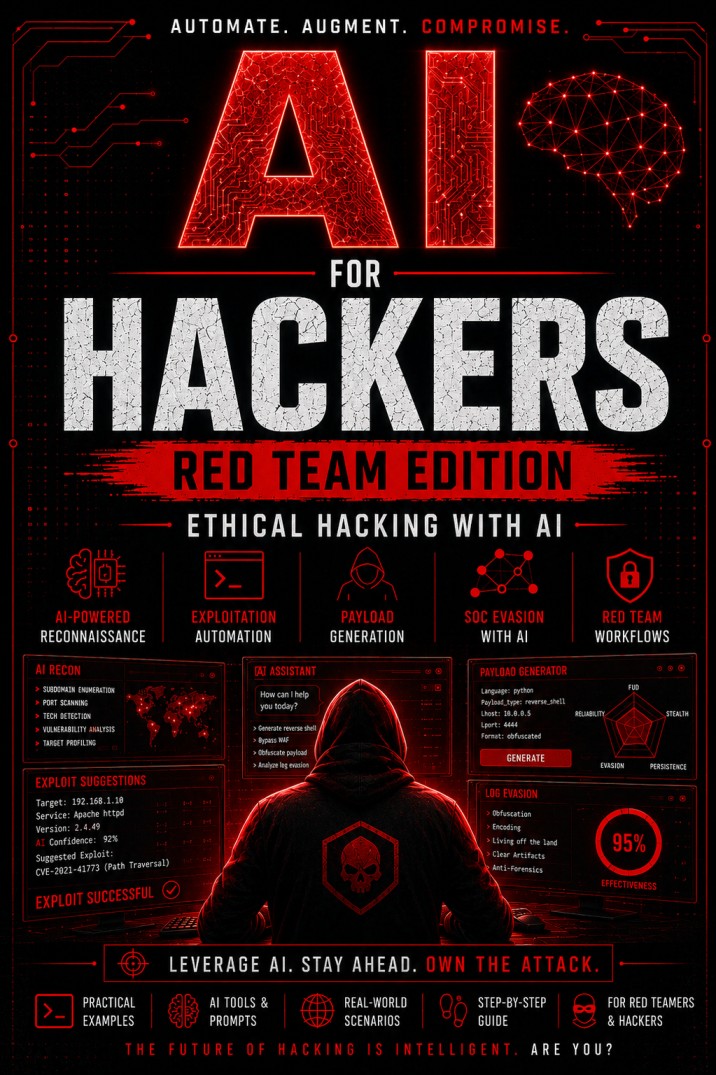
AI for Hackers: Red Team Edition — Ethical Hacking with AI
Original price was: $ 29.99.$ 19.99Current price is: $ 19.99.
AI for Hackers: Red Team Edition is a book by Codelivly that teaches security professionals how to apply artificial intelligence to authorized, ethical hacking. It covers prompt engineering for security, AI-assisted reconnaissance, web application and API testing, cloud and DevSecOps review, secure code review, detection engineering, automation, professional reporting, and bug bounty hunting. The book emphasizes responsible use: AI is treated as an amplifier of the operator, not a replacement for authorization, verification, or ethics. It includes 70 chapters, 170+ prompt templates, 14 hands-on labs, and real-world case studies. It is aimed at penetration testers, red teamers, bug bounty hunters, blue-team analysts, and security engineers.
Description
AI for Hackers: Red Team Edition
Mastering AI for Ethical Hacking, Red Team Workflows, Security Research, Automation, Reporting & Professional Productivity
– By Codelivly
AI for Hackers: Red Team Edition is the complete, ethics-first guide to using artificial intelligence across the entire offensive security lifecycle. In 312 pages, it shows penetration testers, red teamers, bug bounty hunters, and blue-team engineers how to work faster, document better, and think more clearly — without ever crossing the line into unauthorized activity.
This isn’t a book of copy-paste exploits. It’s a book about tradecraft: how a modern security professional uses tools like ChatGPT, Claude, Gemini, GitHub Copilot, and locally-hosted models to compress the tedious work — reading authorization docs, interpreting scans, reviewing code, writing reports — while keeping human judgment firmly in control. Every workflow rests on one uncompromising principle: AI is an amplifier of the operator, not a replacement for authorization, verification, or ethics.
What You’ll Learn
- Prompt engineering for security — write reliable, repeatable prompts and build a reusable library of 170+ battle-tested templates
- AI-assisted reconnaissance & OSINT — turn scattered data into a clean attack-surface inventory, and know when you’ve gathered enough
- Web application & API testing — interpret HTTP, reason about business logic, and think like the application to find flaws scanners miss
- Cloud, containers & DevSecOps — read IAM policies, pipelines, and Kubernetes configs as legible text; treat identity as the new perimeter
- Secure code review at scale — threat-model a codebase, review diffs and pull requests, and catch subtle concurrency and crypto bugs
- Detection engineering & blue/purple teaming — build durable, behavior-based detections and hunt threats as a conversation
- Security automation — build tools that last, test them properly, and know exactly what not to automate
- Professional reporting — turn twelve hours of writing into two, and craft findings that actually get funded
- Bug bounty & continuous security — prioritize under uncertainty, disclose responsibly, and build a sustainable practice
- Private, local AI — run open-weight models on your own hardware for sensitive, regulated engagements
What’s Inside
- 📘 312 pages across 14 parts and 70 chapters
- 💬 170+ ready-to-use prompt templates for every phase of an engagement
- 🧪 14 hands-on labs to build the habits, not just read about them
- 📊 Real-world case studies — narrated, end-to-end, authorized engagements
- ✅ 15 appendices — checklists, reporting templates, and a 150-term glossary
- 🔖 Clickable table of contents & full PDF bookmarks for easy navigation
Who This Book Is For
Whether you’re a penetration tester, red team operator, bug bounty hunter, SOC/blue-team analyst, security engineer, DevSecOps practitioner, or a student breaking into the field, this book meets you where you are. Each part is written to stand on its own, with a suggested reading path for your role — so you can start with fundamentals or jump straight to the workflows you need today.
Why It’s Different
Most “AI + hacking” content is either hype or a thin list of prompts. This book teaches the judgment that makes AI genuinely useful in professional security work: when to trust an answer, how to verify it, where to keep a human in the loop, and how to protect client data at every step. It’s the difference between someone who uses AI and a professional whose skill compounds because of it.
Strictly for authorized, ethical, and defensive use. No malware, no exploitation payloads, no techniques whose only purpose is harm — just the discipline of doing excellent security work, responsibly, at the speed AI makes possible.
Frequently Asked Questions
What is AI for Hackers: Red Team Edition? It’s a 312-page practical guide by Codelivly on using artificial intelligence for authorized, ethical hacking and cybersecurity. It covers prompt engineering, reconnaissance, web and API testing, cloud and code review, detection engineering, automation, reporting, and bug bounty hunting — all with a strict focus on responsible, authorized use.
Is this book legal and ethical to use? Yes. Every technique assumes you have explicit, written permission to test the systems you touch. The book does not teach how to break into systems you don’t own, build malware, steal credentials, or evade defenses you weren’t hired to evaluate. Its entire framework is built around authorization, verification, and professional ethics.
Do I need to be an expert to read it? No. The book is written for a range of skill levels — from students and newcomers to seasoned professionals. It starts with AI and security fundamentals and progresses to advanced, real-world workflows, with a suggested reading path for each type of reader.
Which AI tools does it cover? It teaches durable skills that apply to any capable model — including assistants like ChatGPT, Claude, and Gemini, coding tools like GitHub Copilot, and open-weight models you can run locally for sensitive work. Because it focuses on principles over specific products, the material stays relevant as tools evolve.
Will this book become outdated as AI changes? The specific tools will change; the discipline won’t. The book deliberately invests in what lasts — judgment, verification, data-handling, prompt libraries, and workflows — so the skills carry forward through every new model release. An entire section is dedicated to staying current without chasing hype.
Does it include prompts and templates I can actually use? Yes. It contains 170+ ready-to-use prompt templates, plus reporting templates, checklists, 14 hands-on labs, and a glossary — all designed to drop straight into your real (authorized) work.
Who is the author? The book is written by Codelivly (www.codelivly.com), a cybersecurity education brand focused on practical, hands-on security skills.
Is this a coding or programming book? It’s a security tradecraft book that uses AI. You’ll see code and automation, but the focus is on the workflows and judgment of professional security work — recon, testing, review, detection, reporting — accelerated by AI, not on teaching a programming language from scratch.
Can I use it for bug bounty hunting? Yes. A full part is dedicated to applying AI to bug bounty — prioritizing targets under time pressure, learning unfamiliar tech fast, verifying findings, and writing clear, respectful disclosure reports that earn acceptance and reputation.
Related products
-
Cybersecurity Foundations: How Not to Be Useless
Every chapter is laser-focused on preventing critical mistakes that waste time, energy, and money. If you’re…
$ 9.99 Grab Yours -

AI for Hackers: A Beginner’s Guide to Machine Learning in Cybersecurity
You’ll also learn how to build an AI hacking lab using Python, PyTorch, Scikit-learn, and transformer…
$ 0.00 Grab Yours -

Hack the Mind: The Psychology of Hacking
I wrote this book for everyone — not just tech experts. Whether you’re protecting a company…
$ 3.00 Grab Yours

Reviews
There are no reviews yet.