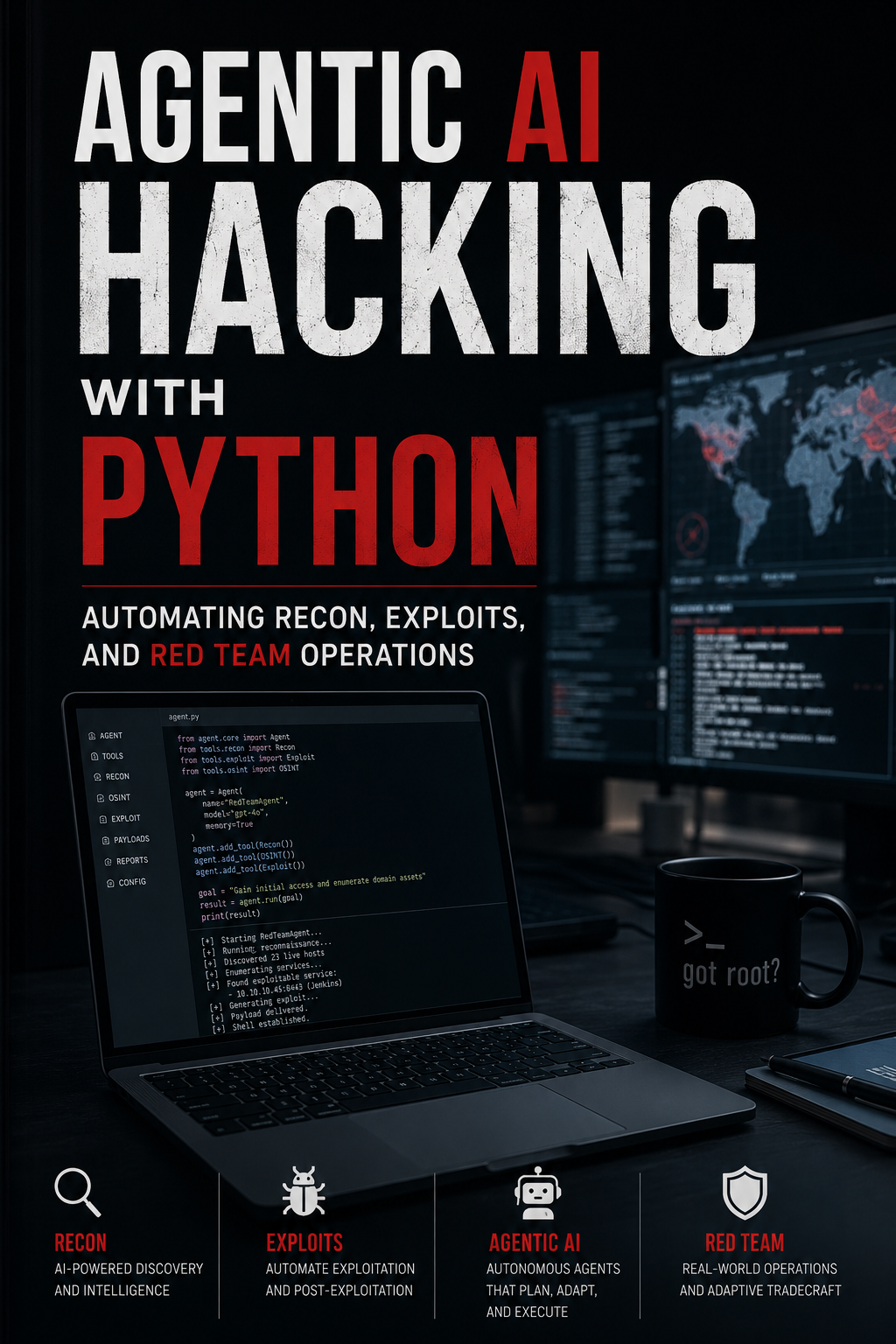
Agentic AI Hacking with Python: Automating Recon, Exploits, and Red Team Operations
$ 19.99
Agentic AI Hacking with Python turns your offensive security scripts into autonomous agents. This Vol. 2 follow-up shows you how to build AI-driven recon bots, adaptive fuzzers, full exploit pipelines, and evasion tools using local LLMs (Ollama), LangChain, and CrewAI — all in Python.
30+ hands-on recipes cover OSINT automation, AI-crafted phishing, LLM-assisted vuln discovery, AD lateral movement planning, RAG poisoning, cloud misconfig hunting, and automated pentest reporting. Lab-only, ethics-first, code you actually run and break.
For pentesters and red teamers ready to go from keyboard operator to AI mission commander.
Description
The hacking playbook just got a brain.
For years, offensive security relied on linear, hardcoded scripts: run a tool, parse the output, move to the next step by hand. But defenders have leveled up with AI-driven EDR, behavioral heuristics, and autonomous threat hunting and the old static-script approach can’t keep pace. Agentic AI Hacking with Python is the Volume 2 follow-up to Python Hacking Recipes, showing security professionals how to build autonomous AI agents that Plan, Act, Observe, and Adapt instead of just executing a fixed sequence of commands.
Across 30+ hands-on chapters and 8 parts, you’ll build a complete arsenal of agentic tools using Python, local LLMs (via Ollama), and orchestration frameworks like LangChain and CrewAI:
- AI-powered reconnaissance — autonomous OSINT agents, LLM-driven subdomain mapping, smart Nmap triage, and instant executive recon reports
- Social engineering at scale — hyper-personalized spear-phishing generators, voice-clone phishing demos, and AI persona crafting for pretexting
- LLM-assisted vulnerability discovery — context-aware fuzzers, local-LLM source code scanners, CVE-to-PoC translators, and GraphQL/REST API abuse agents
- Full exploitation pipelines — a CrewAI-powered recon-to-exploit crew, adaptive SQLi/XSS payload engines, an OWASP Top 10 triage agent, and AI-guided privilege escalation and lateral movement planning in Active Directory
- AI-crafted payloads and evasion — polymorphic obfuscation, AI-driven C2 tasking, and how to red-team your own AI-generated malware against modern detections
- Automated OPSEC — traffic blending, log sanitization, dynamic WAF fingerprinting and bypass, and an OPSEC risk scorer for your own engagements
- Cloud and LLM-native attack surfaces — AWS misconfiguration hunting, RAG pipeline data poisoning, system prompt extraction, and container/Kubernetes escape paths
- Reporting and career growth — a 60-second pentest report generator, automated CVSSv3 scoring, a ReAct-based CTF solver, and a forward look at MCP servers, agent swarms, and the threat landscape through 2027
Every recipe includes complete, runnable code you’re meant to type out, break, and rebuild — with a strong emphasis on keeping your reasoning local (Ollama-first) so sensitive target data never touches a third-party API. This is a lab-only, ethics-first book: it opens with a clear authorization and legal-scope disclaimer, and every technique is framed for use in isolated environments, authorized bug bounty scopes, and sanctioned red team engagements.
Whether you’re a penetration tester, red teamer, bug bounty hunter, or security engineer looking to move from “keyboard operator” to AI mission commander, this book gives you the practical, code-first foundation to build your own autonomous offensive security tooling.
What you need: working Python knowledge and familiarity with basic security/pentesting concepts. No prior AI/ML experience required the book teaches the agentic concepts (ReAct loops, tool calling, multi-agent orchestration) from the ground up.

Reviews
There are no reviews yet.